Review
Recharge Please!
4.2 out of 5 on Google Play · 74K ratings
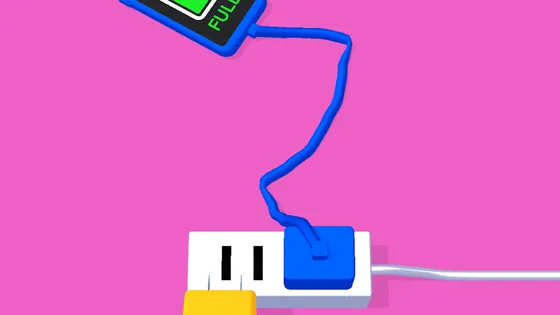
Recharge Please! gives you a board of plugs and a board of sockets and exactly one rule: the cables may not cross. Each plug matches one socket by shape, so working out which goes where takes no time at all — the entire puzzle is the order in which you route them.
Geisha Tokyo, Inc. has kept it to a single finger and a single constraint, and that restraint is why it sits at the top of this catalogue. It is the most immediately enjoyable of the seven and the one I would hand to somebody who says they do not like puzzle games.
Cold start: your first board
The first boards carry three plugs and no possible tangle. You clear them without thinking, which is precisely their job — they teach the drag and nothing else.
The game arrives properly at the first board where the obvious route for the second cable blocks the fourth. That moment, when you realise the problem is a sequence rather than a set of paths, lands somewhere around level ten, and everything afterwards builds on it.
How it looks, and how well you can read it
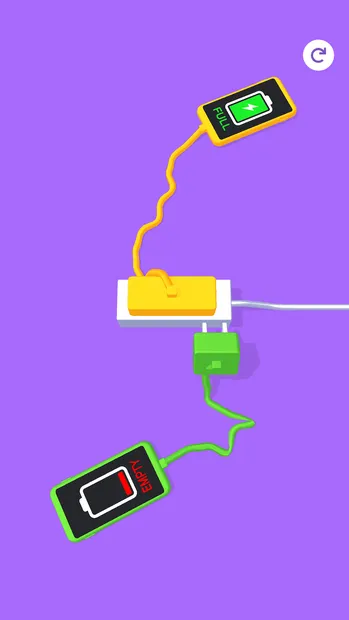
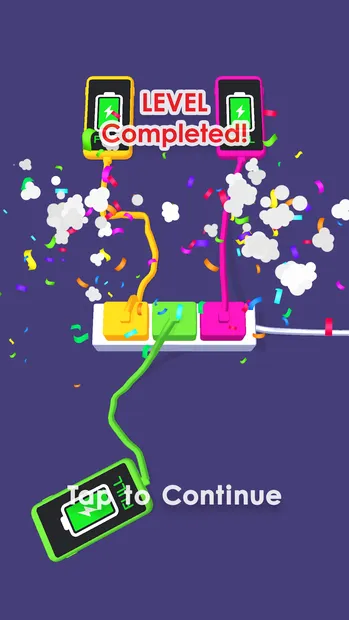
Bright, chunky and high-contrast, with plug shapes distinguished by silhouette as well as by colour. For a matching game that is the correct priority, and it means a board reads instantly even at a glance on a moving train.
The one weak point is cable overlap rendering. When several cables run close together the rule stays unambiguous and the picture does not — on a dense board I occasionally had to drag a cable aside simply to see whether two lines were touching.
Recharge Please! at a glance
- Developer
- Geisha Tokyo, Inc.
- Platform
- Android
- Session length
- Two to eight minutes
- Entry barrier
- Immediate
- Controls
- Drag a plug across the board
- Offline
- Plays fully offline
- Orientation
- Portrait
- Content rating
- General
- Levels stated on Play
- Not stated on Play
- Last updated on Google Play
- Aug 5, 2026
Store details checked on 10 September 2026 against the Australian Google Play storefront. Open the Recharge Please! listing on Google Play.
What separates it from the obvious comparisons
Of the seven games here, this is the only one where you move things rather than turn them. Power On, Powerline and Energy all rotate tiles in place, which is a question of local correctness; here nothing is ever in the wrong orientation, only in the wrong order.
Light Connect is the closest relative, because it is also about routing a line that must not meet another. The difference is that Light Connect gives you a grid to travel along and specified points to visit, while this gives you open space and only the no-crossing rule. One is a constrained path problem, the other is a free one, and they exercise noticeably different instincts.
The level list and the long tail
Boards get larger and the tangles denser, and that is the whole of the progression. No new mechanic appears after the first few dozen levels, no mode change, no structural surprise.
What keeps it alive longer than that suggests is how cleanly the difficulty scales. A board with eight plugs really is harder than one with five in a way you can feel, and the game never needs to add anything to make the next one worth doing.
The part that lasts
The skill is sequencing, and it keeps developing. After a week you start reading which plug has the fewest viable routes and doing that one first, which is exactly the heuristic the harder boards are built to demand.
It does plateau. Somewhere past the two-hundredth board the tangles stop teaching you anything and simply take longer. That is a respectable life for a one-rule game, and it is still the most life any of these seven manages.
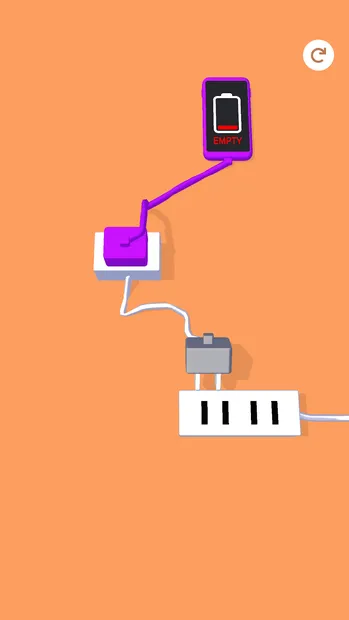
Three frames from the game
What works, and what does not
In its favour
- A single rule that produces genuinely spatial problems
- Plug shapes are distinguishable by silhouette, not colour alone
- True one-finger play in portrait, comfortable on any phone
- Fully offline with no interruption between boards
Against it
- Cable overlap is visually muddy on dense boards
- No new mechanics after the opening levels, only bigger tangles
- A clear plateau once the sequencing heuristic clicks
The verdict
The best of the seven and the easiest to recommend. It is not the deepest thing here — Powerline is — but it is the best made, the most comfortable to hold and the only one that is fun immediately rather than eventually.
Scores on this site run from 6.1 to 8.7 and are one person’s judgement. How the scoring works.