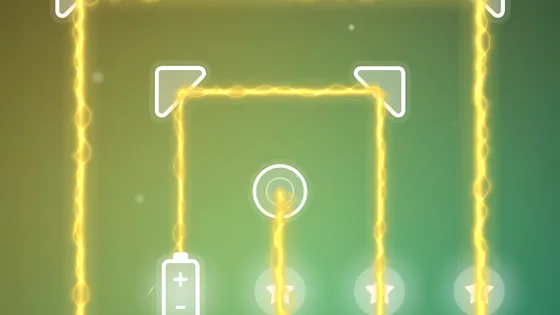
Recharge Please!
Drag every plug to the socket that fits it without letting the cables cross. One finger, one rule, and a genuinely spatial problem underneath.
8.72–8 minOne-finger drag
Seven free Android puzzle games about getting power from one end of a board to the other — wires, mirrors, beams and plugs. Played on a phone rather than in a screenshot, and written up by one person in New South Wales. Seven full reviews, seven scores, and no filler between them.




Seven titles, seven full reviews — every one of them shown here
| Game | What it asks of you | Controls | Clock and limits | Entry | Offline | Our score |
|---|---|---|---|---|---|---|
| Recharge Please! | Untangling | One-finger drag | No clock, no move limit | Immediate | Yes | 8.7 |
| Laser: Relaxing and Satisfying | Calm deduction | Tap to rotate | No clock, unlimited restarts | Very gentle | Yes | 8.4 |
| Powerline - Logic Puzzles | Efficient orientation | Tap to rotate | No clock, rotations counted | Easy start | Yes | 8.0 |
| Energy: Anti-Stress Loops | Closing loops | Tap to rotate | No clock, no move limit | Immediate | Yes | 7.6 |
| Light Ignite - Laser Puzzle | Continuous optics | Free drag and rotate | No clock, free experimentation | Easy start | Yes | 7.5 |
| Light Connect | Circuit tracing | Drag to trace | No clock; undo available | Immediate | Partial | 7.3 |
| Power On: Energy Flow | Orientation | Tap to rotate | No clock, no move limit | Very gentle | Yes | 6.1 |
The clock-and-limits column is the one worth reading first. Six of the seven impose nothing at all, and the seventh — Powerline — counts every rotation you make, which is the single biggest difference between any two games on this list.
All seven, in the order I would install them. Each links to a full review of between four hundred and nine hundred words.
Drag every plug to the socket that fits it without letting the cables cross. One finger, one rule, and a genuinely spatial problem underneath.
8.72–8 minOne-finger drag
Soft synths, gentle haptics and mirrors on a dark grid. The rare relaxation puzzle that still poses a proper question every few boards.
8.45–20 minTap to rotate
The same wires and lamps as its neighbours, with one change that alters everything: every rotation is counted, and the board keeps score.
8.05–15 minTap to rotate
Tap segments to rotate them until every bolt reaches a lamp through a closed loop. Deliberately, almost aggressively calm.
7.62–12 minTap to rotate
Lenses, prisms and black holes with continuous optics behind them — the only game here where the beam bends rather than turns.
7.55–25 minFree drag and rotate
Trace one unbroken line from each battery through every bulb of its colour. Simple to state, and harder once three circuits share a board.
7.33–12 minDrag to trace
Rotate the wires until the current reaches every lamp. Three hundred boards of deliberate calm, with a difficulty curve that barely leaves the ground.
6.13–10 minTap to rotate
Every review carries a number out of ten. It is one person’s judgement, formed by playing the game on a phone in the conditions phones actually get used in — and it is the least useful thing on the page.
Whether the central rule generates decisions rather than only busywork; how legible the board stays in daylight, on a bus, at arm’s length; how much of a session goes on something other than the puzzle; and whether anything is left to learn after the first week.
Popularity is not part of it. The lowest-scoring game here has a perfectly respectable store rating and the highest has fewer ratings than three of the others.
Which kind of thinking you enjoy. Tracing a route, computing a reflection, planning under a budget and nudging a continuous simulation are different activities, and being good at one says very little about the rest.
That is why each review spends longer on what a game asks of you than on any verdict. The full method, including what is checked and when, is set out on the scoring page.
The questions that arrive most often by e-mail, answered plainly.
Yes. Every game reviewed here is listed as free to play on Google Play, and no purchase is required to start any of them. Reviews on this site do not discuss what a game sells, only what it plays like.
Because the subject is deliberately narrow: free Android puzzles about current, light and charge. Seven is roughly how many are worth a full review at any one time, and padding the list would mean either widening the subject or writing about things that do not deserve the space.
From each game’s Google Play listing on the Australian storefront, checked on the date printed at the top of every review. Those values change over time, so if a rating here differs from what you see today, the Play listing is the correct one.
One person: Angus Fraser, in New South Wales. There is no editorial team and no testing panel. Every score on the site is a single individual’s judgement, which is stated plainly on the scoring page.
No. This site is independent, has no relationship with any developer whose games appear here, and is not affiliated with or endorsed by Google LLC. Screenshots and icons belong to their respective rights holders and appear here to illustrate the reviews.
Because the Google Play listing for that game does not publish one. Where a developer states a number it is quoted; where none is given, inventing a figure would be worse than admitting the gap.
One address, read by one person. Corrections to factual details are the most useful thing you can send.
Written and maintained by Angus Fraser, 225 Morrison Rd, Putney NSW 2112, Australia, telephone +61 2 8095 8904. Corrections to any factual detail are the most useful thing you can send.
Write to desk@stagejury.com.
This site stores one functional key in your browser so this notice stays dismissed. Nothing else is stored, and there is no analytics or advertising here. Read what is stored.