Review
Laser: Relaxing and Satisfying
4.4 out of 5 on Google Play · 112K ratings
Most games that call themselves relaxing get there by removing the puzzle. Laser: Relaxing and Satisfying is the exception — it removes the pressure and keeps the problem, which is a much harder thing to do.
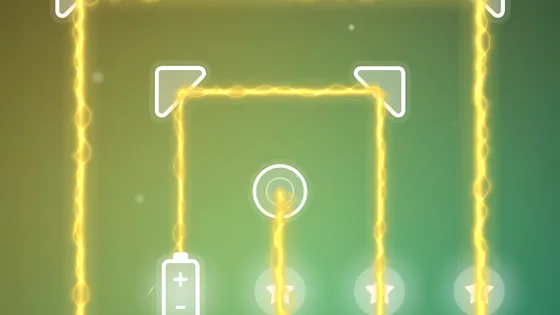
The board is a dark grid, mirrors rotate on a tap, and there is no clock, no move limit and no penalty for restarting. What remains is a steady sequence of small spatial questions delivered at whatever pace you feel like, with a soundtrack and a set of haptics doing quiet work underneath.
Taps, drags and reach
A tap rotates a mirror through its available orientations, and that is the entire vocabulary. Targets are large, the animation is quick, and the response never lags — which matters more than it sounds when a board has twenty mirrors and you are cycling several.
The haptics are the part worth singling out. A completed beam produces a distinct short pulse, so on a board where the visual change is subtle your hand knows before your eyes do. It is the best use of vibration in this catalogue and the only case where switching it off makes a game measurably worse.
Board readability and art direction
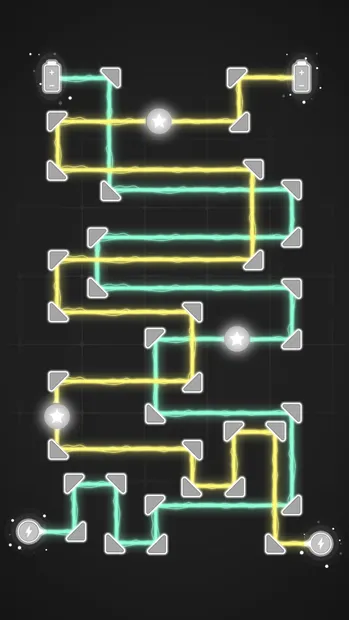
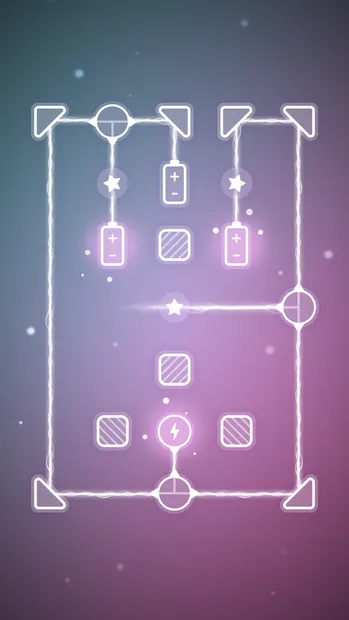
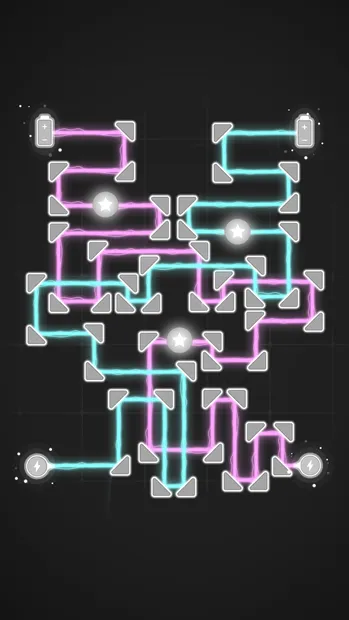
Dark background, single-colour beam, mirrors as pale outlines. The contrast between live and dead segments is strong enough to read in bright daylight, which two of the other six cannot manage.
Optional backgrounds and beam colours are offered and most of them make the board harder to read. The default is the best setting here, and the customisation is decoration rather than accessibility.
Laser: Relaxing and Satisfying at a glance
- Developer
- Infinity Games, Lda
- Platform
- Android
- Session length
- Five to twenty minutes
- Entry barrier
- Very gentle
- Controls
- Tap a mirror to rotate it
- Offline
- Plays fully offline
- Orientation
- Portrait
- Content rating
- General
- Levels stated on Play
- Not stated on Play
- Last updated on Google Play
- May 20, 2026
Store details checked on 10 September 2026 against the Australian Google Play storefront. Open the Laser: Relaxing and Satisfying listing on Google Play.
How it differs from the other six
Light Ignite is the other beam game here and the two could hardly be less alike. Light Ignite simulates continuous optics, so a solution is a region you have to find by nudging; this snaps everything to a grid, so a solution is a configuration you can compute in your head before touching anything.
Against the rotation puzzles — Power On, Energy, Powerline — it shares the tap-to-turn gesture and differs in what the turning does. Those carry current along a wire that either connects or does not; here a mirror redirects a beam that continues travelling, so one change can alter the picture several cells away.
Not for everybody
Anybody looking for escalating difficulty will be disappointed. The curve is deliberately shallow and the game never tries to defeat you — the hardest boards here are a fraction of what Powerline asks once its budget starts biting.
It is also no use if you dislike the core action. Two hundred boards of tapping mirrors is two hundred boards of tapping mirrors, however pleasant the sound design, and no amount of ambient synth converts somebody who finds reflection puzzles tedious.
The level list and the long tail
Boards arrive in packs and grow in size rather than in rule complexity. New elements appear rarely and are always introduced on a board simple enough to make their behaviour obvious.
The interesting structural choice is symmetry. A large share of the level list is built around symmetrical layouts, which means the real skill you develop is spotting the axis and solving half the board. Once that clicks, pack size stops mattering.
Common first-hour errors
The commonest early error is treating every mirror as independent. On a symmetrical board they are not: setting one usually determines its partner, and players who miss that do twice the necessary work on every level.
The second is chasing the beam. The temptation is to follow the light from the source and fix whatever it hits first, but on longer boards the productive move is to work back from the target, because the last few segments have far fewer valid configurations than the first.
The part that lasts
Shallower than Powerline and deeper than it looks. The symmetry heuristic gives you a real method, and the later packs are large enough that applying it well is measurably faster than not.
What lasts is the habit rather than the challenge. This is the game I have kept installed for the specific purpose of ten quiet minutes, and it has survived that role longer than anything else here. That is a real kind of quality, even if it is not the kind that produces a high ceiling.
Three frames from the game
What works, and what does not
In its favour
- Genuinely relaxing without removing the puzzle underneath
- The best haptic feedback in the catalogue
- Strong contrast that stays readable in daylight
- Symmetry-led boards give you a real method to learn
Against it
- A deliberately shallow curve that never seriously tests you
- Most of the optional backgrounds make the board harder to read
- Very little new after the first few packs beyond board size
The verdict
The best-behaved game here and the one most likely to still be installed in a year. It will not challenge anybody who wants to be challenged, but as an evening wind-down that respects your intelligence it is close to ideal.
Scores on this site run from 6.1 to 8.7 and are one person’s judgement. How the scoring works.