Review
Light Connect
4.5 out of 5 on Google Play · 44.1K ratings
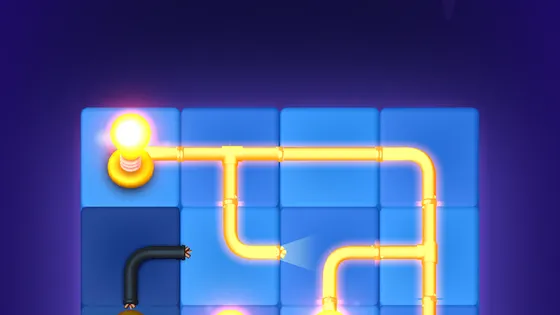
Light Connect puts a battery and a scattering of bulbs on a dark grid and asks for one continuous line that visits all of them. Drag from the battery, thread the line through each bulb of its colour, and the board lights when the circuit is complete and unbroken.
On a single-colour board that is barely a puzzle. The game arrives when two or three circuits share the same grid, because they may not cross, and a route that services your red bulbs perfectly can leave the cyan battery with nowhere to go. GOODROID,Inc. has kept the presentation clean and the rule count at one, and the 4.5 rating from more than forty thousand ratings suggests the balance is about right.
The first ten minutes
The opening boards are four cells square with a single battery and two bulbs, and they exist purely to teach the drag. You will clear a dozen without stopping to think, and the game does not pretend otherwise — the level numbers climb quickly because nothing is being asked yet.
The first board with two colours is where it starts. Both circuits are individually trivial and only one arrangement lets them coexist, and working that out takes a genuine minute the first time. From there the boards keep the same rule and simply add a third colour, more bulbs and a tighter grid, which is a cleaner escalation than most of the seven manage.
One small mercy worth knowing about from the start: the undo control sits in the top bar rather than buried in a menu, so backing out of a bad route costs one tap rather than a restart.
Session length in practice
Three to twelve minutes covers almost every sitting. Boards are short, progress saves between them, and the level number gives you an obvious place to stop — which sounds trivial and is the difference between a game you close and a game you drift out of.
The awkwardness is what sits between the boards. This is an advertising-supported puzzle and the interruptions arrive on a schedule of their own, so a fifteen-minute session contains noticeably less puzzling than the same fifteen minutes spent in Recharge Please! or Powerline. It never blocks you and it is never lengthy, but it is the reason this scores where it does rather than higher.
For a five-minute break it is fine. For a long uninterrupted stretch there are better things here.
Light Connect at a glance
- Developer
- GOODROID,Inc.
- Platform
- Android
- Session length
- Three to twelve minutes
- Entry barrier
- Immediate
- Controls
- Drag along the grid to lay the line
- Offline
- Boards play offline
- Orientation
- Portrait
- Content rating
- General
- Levels stated on Play
- Not stated on Play
- Last updated on Google Play
- May 18, 2026
Store details checked on 10 September 2026 against the Australian Google Play storefront. Open the Light Connect listing on Google Play.
The audio side, headphones off
A soft electrical hum under everything, a rising tone as each bulb comes on, and a warm chord when the last one lights. The tone rising per bulb is the useful part — on a board with seven bulbs you can hear how close the circuit is without counting.
It is decorative rather than load-bearing. Nothing is communicated by sound that the glowing line does not already show, so playing muted costs you only atmosphere, and given that this is exactly the kind of game people open in a waiting room that is the right way round.
The one complaint is the completion chord, which is longer than it needs to be and cannot be skipped. Over a run of twenty short boards those seconds add up more than you would expect.
Not for everybody
Anybody who wants a puzzle to resist them will find the first fifty boards close to empty. The escalation is real but slow, and the game will not properly test you until the three-colour grids arrive.
It is also a poor pick if you dislike interruptions between levels. The puzzle itself is clean and quiet and the rhythm around it is not — if that combination irritates you, Recharge Please! is a very similar act of untangling with far less traffic around it.
And if your instinct from other connection puzzles is to cover the whole board, unlearn it here. A line has to visit specified points and nothing else; empty cells are fine, and trying to fill them will cost you an evening of confusion.
Three frames from the game
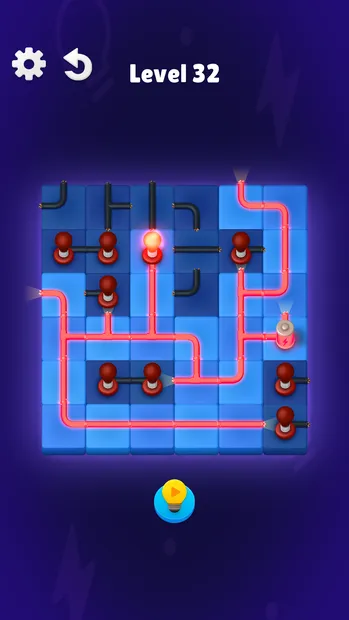
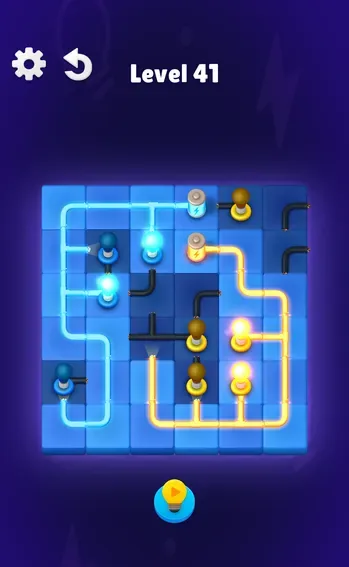
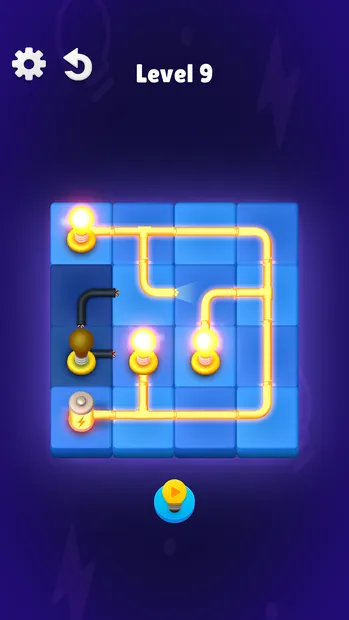
What works, and what does not
In its favour
- A single rule that produces real conflicts once several circuits share a board
- Undo is one tap and lives in the top bar, so a bad route costs nothing
- Rising audio tone quietly reports how close a circuit is to complete
- Clean, high-contrast board that stays readable at any size
Against it
- The first fifty boards ask almost nothing of you
- Interruptions between levels eat a real share of a short session
- The completion chord is long and cannot be skipped
- Circuit colours carry the whole distinction, with no secondary cue
The verdict
A tidy, likeable circuit puzzle that takes a while to become one. The multi-colour boards are genuinely good and the presentation is the cleanest here; the cost is a slow opening and a rhythm set by something other than the puzzle. Worth installing, worth skipping ahead in.
Scores on this site run from 6.1 to 8.7 and are one person’s judgement. How the scoring works.