Review
Powerline: Logic Puzzles
4.3 out of 5 on Google Play · 18.2K ratings
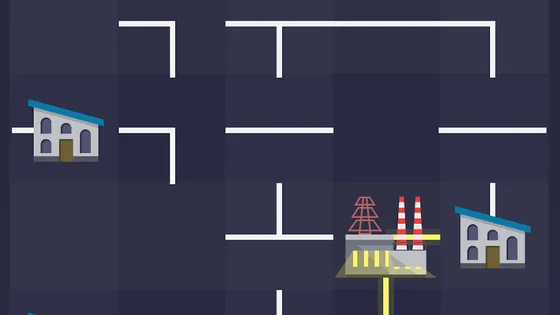
Powerline looks identical to the other rotation puzzles here and plays like none of them, because of one number above the board. Each level starts with a budget, every rotation reduces it, and what remains at the end becomes your rating.
Leaflock has taken the genre’s biggest weakness — that brute force always works — and made it expensive. The result is a game that asks you to look before you touch, which is the single most valuable thing a rotation puzzle can do.
What the opening levels teach you
The first dozen boards give you far more budget than you need, and most people will not notice the counter at all. That is a deliberate soft opening, and it means the mechanic that defines the game is invisible for the first ten minutes.
The moment it lands is the first board you finish with the budget nearly gone and a poor rating instead of a good one. From there you start solving in your head first, and the game becomes a different exercise entirely.
Colour, contrast and clutter
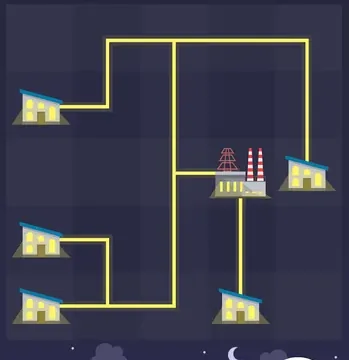
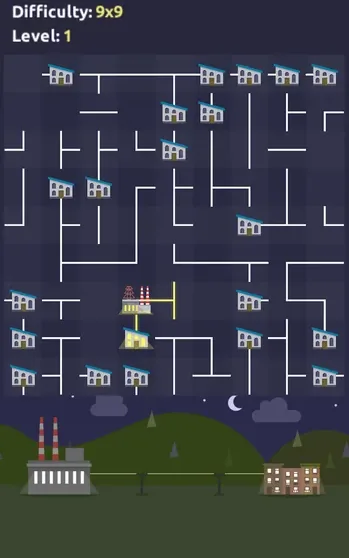
Plain and functional: wires in pale grey, live sections in a warm colour, houses as simple blocks against a night landscape. It is not beautiful and it is perfectly readable, which for a puzzle this fiddly is the right priority.
The budget counter is the one piece of interface that matters and it sits where you will see it, above the board rather than tucked into a corner. On the largest fields the tiles shrink enough that a compact phone starts to struggle, and that is the only real readability complaint.
Powerline - Logic Puzzles at a glance
- Developer
- Leaflock
- Platform
- Android
- Session length
- Five to fifteen minutes
- Entry barrier
- Easy to start, awkward to do well
- Controls
- Tap a tile to rotate it
- Offline
- Plays fully offline
- Orientation
- Portrait
- Content rating
- General
- Levels stated on Play
- Two modes, count not stated
- Last updated on Google Play
- Aug 10, 2026
Store details checked on 10 September 2026 against the Australian Google Play storefront. Open the Powerline - Logic Puzzles listing on Google Play.
Not for everybody
Anybody who solves rotation puzzles by fiddling will find the counter nagging rather than motivating. There is no mode that turns it off, so if scoring pressure annoys you there is no way to opt out.
It is also the wrong choice for very short bursts. Solving in your head before touching anything takes a minute or two of looking, and if you only have three minutes you will brute-force and rate badly, which is the least satisfying way to play it.
How it holds up without a connection
Fully offline. Boards, ratings and the score table all live on the device, and nothing needs a connection at any point.
The rating table being local is worth mentioning, because a scoring game that pushed you towards an online comparison would feel very different. This one keeps the competition entirely between you and your previous attempt.
The level list and the long tail
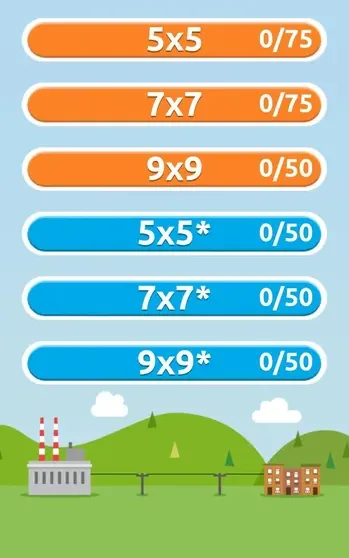
Two modes, and the second is not a difficulty setting so much as a different game. Hard mode wraps the field edges, so a wire leaving the right side returns on the left, which breaks the visual reasoning that carried you through the first mode.
That wrap-around trick is the best idea in the catalogue. It takes a genre where experienced players stop thinking and forces them to start again, and the budget makes the relearning process properly uncomfortable.
Mistakes most people make early
The dominant early error is rotating to see what happens. In every other game here that is free; here it is the difference between a good rating and a poor one, and the habit takes real effort to break.
The second is solving from the lamps backwards. With a budget, the efficient route is almost always to fix the tiles next to the source first, because every tile you settle removes ambiguity from its neighbours. Working backwards from the ends means re-touching the middle twice.
What is left once the trick is understood
The budget gives this catalogue its only genuine skill ceiling. Completing a board is easy; completing it near the theoretical minimum requires holding the whole solution before your first tap, and that keeps improving for a long time.
Hard mode extends it further than the level list alone would suggest. It is not the prettiest or friendliest game here, but of the four rotation puzzles it is the only one still asking me questions after a fortnight.
Three frames from the game
What works, and what does not
In its favour
- The rotation budget turns a brute-forceable genre into a real thinking game
- Hard mode’s wrap-around edges genuinely reset your intuition
- Fully offline with local scoring and no online comparison
- Rating feedback is immediate and legible
Against it
- No way to turn the scoring off if you dislike the pressure
- Presentation is the plainest of the seven
- Tiles get small on the largest fields
- Poorly suited to sessions shorter than about five minutes
The verdict
The thinking person’s pick. It is the least polished of the rotation puzzles and by a distance the most interesting, because it is the only one that makes carelessness cost something. Give it until the first board you finish with an empty budget.
Scores on this site run from 6.1 to 8.7 and are one person’s judgement. How the scoring works.